It is common knowledge that exercise is good for us. Even though we understand this, many US adults and adolescents do not get enough activity.5 Being sedentary contributes to muscle and bone loss as we age, leading to frailty and reduced independence.
To address this, we will cover the basics to make a personalized strength routine that can improve longevity and independence as we age.
Strength Principles
There is no one-sized-fits-all program, each plan should consider:
- Equipment access
- Available time
- Training experience and skill
- Injury history
- Goals
Frequency
Frequency is how many days per week you train.
- A good goal is to exercise each muscle group 2-3 times a week separated by 24-48 hours rest before hitting the same muscle.1,3,5
Volume
- A rep is one controlled repetition.
- A set is a sequence of reps performed without rest.
- For larger multi-joint, a rest period of 2-3 minutes may be required while lighter exercises may only need 30-90 seconds.
A good starting volume is 8-12 reps, 1-4 sets, 2-3 times a week.6
The volume of working sets per muscle should be 8 up to 25 sets. For most people, 12 -18 sets per week balances volume recovery.
Timing your rest periods can help keep workouts to a sustainable length.
Intensity
Intensity is how close you are to muscular failure at the end of a set.
- Most productive sets end with 1-4 reps in reserve (RIR) (meaning you could do 1-4 more reps). If you complete a set with 5-10 RIR, the adaptation to grow is likely low for that set to count outside of a warmup or deload context.
- For beginners, a good starting point is 60% of their 1 rep maximum (1-RM) and to progress towards 80% of 1-RM.6 Older and deconditioned individuals should often begin at 40-50% of 1-RM or use a rating of perceived exertion (RPE) of 5-6/10.6
The goal is to train hard enough to signal your body to grow stronger, without risking injury or poor recovery.
Progression
You adapt when the intensity increases over time.
Progression may occur by increasing
- Weight
- Repetitions
- Sets
- Speed of repetition
- Range of motion
- Frequency per week
Sample progression:
- Pick a rep range, (8-12). When you can hit 12 reps with good form, increase the weight, (2.5-5 lbs for upper body or 5-10 lbs for lower body) and drop the reps back down. Then slowly build back up to the top rep with good form at the new weight
Early on, prioritize proper form with lighter weights before progressing to avoid poor movement patterns and injury.
Exercise Type
There are many options for exercises. The best strategy is to pick exercises that you will actually do.
- Free weights use dumbbells, barbells, and kettlebells and require healthy joints and skill to perform.
- Machines offer a stable range of motion that is beginner-friendly and easy to learn.
- Body weight exercises require no equipment but can be harder to progress or regress.
- Single joint exercises are those which target a specific set of muscles across a joint such as a bicep curl or knee extension.
- Multi-joint exercises recruit more muscles and are the more time efficient.
Practical guideline: perform compounds (e.g., deadlifts) before single-joint isolation exercises.2
Reversibility (Use it or Lose it)
Without continuous exercise, adaptations will be lost in as little as 2-6 weeks.2 This means that consistency is superior to perfection, especially long term.
Individualization
Your program should match your:
- Unique goals
- Time constraints
- Injury history and medical conditions
- Preferences
Construct a program that you enjoy to support long-term consistency.
Program Structure
You can train:
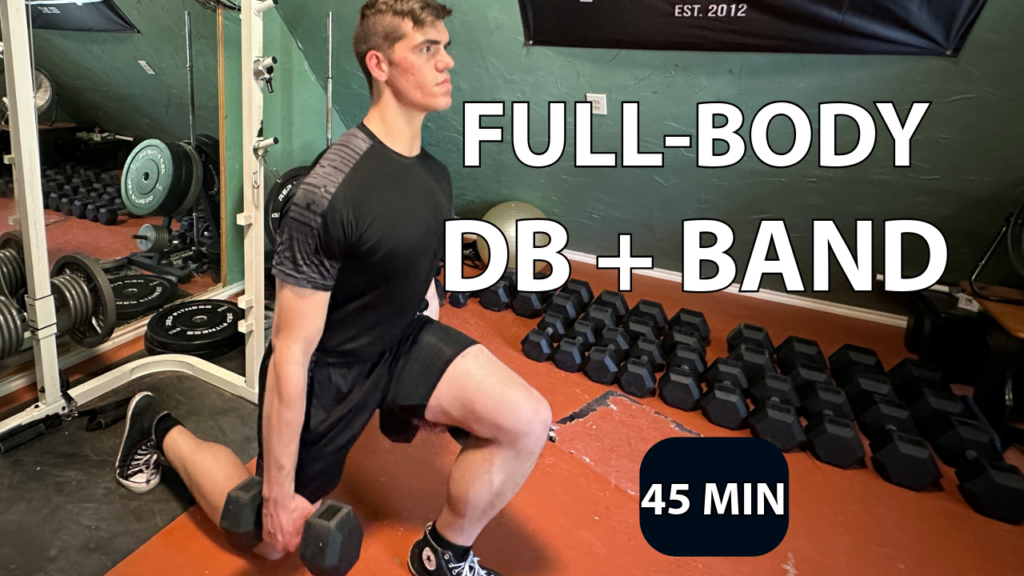
- Full body (each session hits most muscle groups)
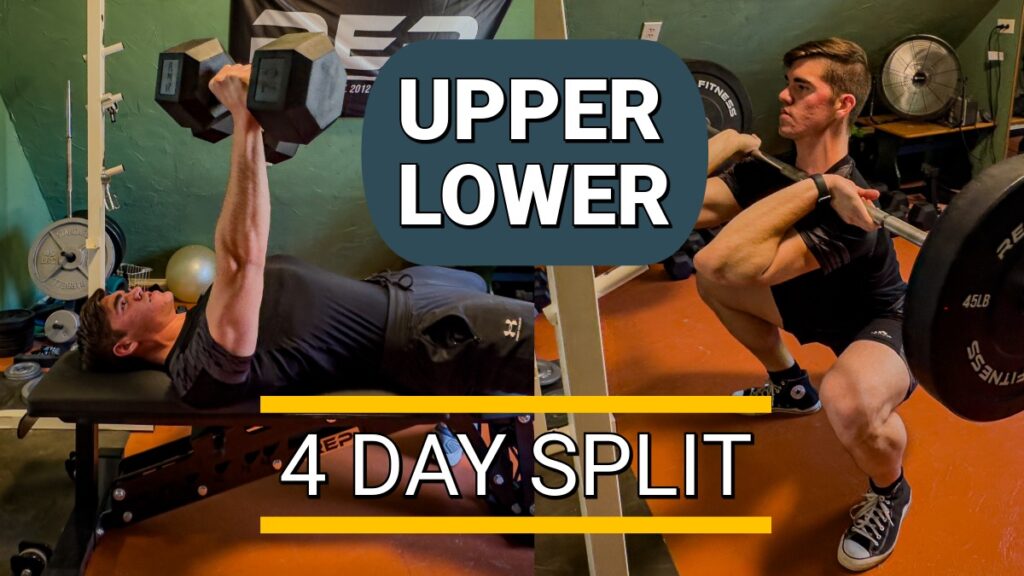
- Split routines (upper/lower, push/pull/legs, etc.)
Both methods are effective to increase strength and muscle mass. Ideally, each muscle group has a weekly frequency of 2-3 days.6 This means that a full body routine will have a minimum frequency of 2+ days/week and a split routine such as upper-lower will need to be done 4 days/week.
Programming by Frequency
One Day per week
Training once a week is much more effective than no training. Full body days can feel exhausting because of the longer workouts and higher daily volume. If you’re overwhelmed or tight on time, only do the first four movements (squat, hinge, horizontal push, and horizontal pull) and leave.
Total Body Essentials
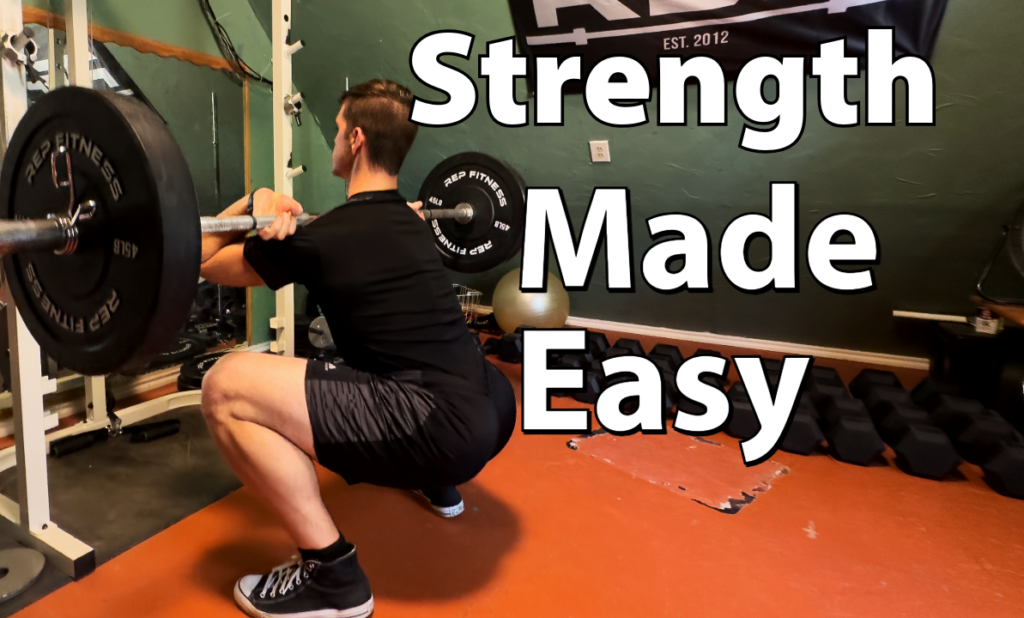
- Squat: Leg press, goblet squat, barbell front squat 2-3 sets x 8-12 reps
- Hinge: Deadlift, romanian deadlift, or trap bar deadlift 2-3 sets x 6-10
- Horizontal Push: Push-ups or bench press 2-3 sets x 8-12 reps
- Horizontal Pull: Cable row or dumbbell row 2-3 sets x 8-12 reps
- Carry or Core: Farmers carry or plank: 2-3 sets of 30-90 seconds
For a comprehensive full-body session, add:
- Vertical Push: Dumbbell overhead press 2-3 sets x 8-12 reps
- Vertical Pull: Lat pulldown or assisted pullups 2-3 sets x 6-12 reps
Two Days per week
Goal: Train all major muscle groups in the body twice a week.
Full Body Day A
- Squat: leg press, goblet squat, or barbell front squat 3 sets x 8-12 reps
- Bench press or pushups: 2-3 sets x 8-12 reps
- Cable Row: 2-3 sets x 8-12 reps
- Lunge or Leg Extensions: 2 x 8-12
- Lateral Raises 2 sets x 10-15 reps
Full Body Day B
- Romanian deadlift or trap bar deadlift: 3 sets x 6-10 reps
- Dumbbell Overhead press: 2-3 sets x 8-12 reps
- Lat Pulldown or assisted pullup: 3 sets x 6-12 reps
- Hamstring curls: 2 sets x 8-15 reps
- Calf raises: 2 sets x 10-20 reps
Three Days per week
Goal: More weekly volume with shorter, more sustainable sessions.
Total body
Week 1: A/B/A
Week 2: B/A/B
Workout A
- Squat: 3 sets × 8-10 reps
- Bench: 3 sets × 6-12 reps
- Row: 3 sets × 8-12 reps
- Accessory (lateral raise or curls): 2 sets × 10-15 reps
- Plank, farmer’s carry: 2 rounds of 30-90 seconds
Workout B
- Deadlift: 3 sets × 5-10 reps
- Overhead press: 3 sets × 6-12 reps
- Pulldown / pull-up: 3 sets × 6-12 reps
- Single-leg (split squat/step-up): 2-3 sets × 8-12 reps
- Calf raises or carries: 2-3 rounds
Four Days per week
Goal: More weekly volume per muscle with manageable fatigue and session length
Upper-Lower split
Upper A
- Bench press (dumbbell or barbell): 2-3 sets x 6-12 reps
- Row (machine, barbell, or dumbbell): 2-3 sets x 8-12 reps
- Overhead press (dumbbell or barbell): 2-3 sets x 8-12 reps
- Assisted Pullup: 2-3 sets x 6-12 reps
Lower A
- Squat: Goblet squat, front squat, or leg press 2-3 sets x 6-12 reps
- Deadlift or trap bar deadlift: 2-3 sets x 6-10
- Single-leg (split squat/step-up): 2-3 sets × 8-12 reps
- Calf raises: 2 sets x 15-20
- Plank: 2 x 30-90 sec
Upper B
- Incline bench press: 2-3 sets x 6-12 reps
- Row (machine, barbell, or dumbbell): 2-3 sets x 8-12 reps
- Lateral raise: 2-3 sets x 10-15
- Lat Pulldown: 2-3 sets x 6-12 reps
Lower B
- Forward Dumbbell Lunge: 2-3 sets x 8-12
- Romanian deadlift: 2-3 sets x 6-10
- Calf raises: 2-3 sets x 15-20
- Hanging knee raises: 2-3 sets x 6-20
Key Takeaways:
- If possible, start with a frequency of 2+ days a week to hit each muscle group twice.
- Train with most sets ending 1-4 reps from failure with good form.
- After you easily complete a set with good form, progress (weight, reps, sets, etc).
- Consistency is much more important than perfection, one workout per week is more effective than zero.
References:
- Haff, G., Triplett, N. T., & National Strength & Conditioning Association (Eds.). (2016). Essentials of strength training and conditioning (Fourth edition). Human Kinetics.
- Ratamess, N. (with American College of Sports Medicine). (2012). ACSM’s foundations of strength training and conditioning. Wolters Kluwer Health/Lippincott Williams & Wilkins.
- Kisner, C., Borstad, J., & Colby, L. A. (2023). Therapeutic exercise: Foundations and techniques (Eighth edition). F.A. Davis Company.
- Magyari, P., Lite, R., Kilpatrick, M. W., Schoffstall, J. E., & American College of Sports Medicine (Eds.). (2018). ACSM’s resources for the exercise physiologist: A practical guide for the health fitness professional (Second edition). Wolters Kluwer.
- Piercy, K. L., Troiano, R. P., Ballard, R. M., Carlson, S. A., Fulton, J. E., Galuska, D. A., George, S. M., & Olson, R. D. (2018). The Physical Activity Guidelines for Americans. JAMA, 320(19), 2020–2028. https://doi.org/10.1001/jama.2018.14854
- American College of Sports Medicine. (2018). ACSM’s guidelines for exercise testing and prescription (D. Riebe, J. K. Ehrman, G. Liguori, & M. Magal, Eds.; 10th edition). Wolters Kluwer.
Connect with Me:
- 💡 YouTube – Carter Gansky – YouTube
- 📸 Instagram – Carter R Gansky
- 🐦 Twitter – Carter Gansky (@CarterGansky) / X
- 🌲 Linktree – cartergansky | Twitter, Instagram | Linktree
- 🔊 Discord – https://discord.gg/sQxvHH78Ga
Get in touch:
For collaborations or other business inquiries.
Disclaimer:
This content is for educational purposes only and does not constitute the practice of health care services, including the giving of medical advice, and no doctor/patient relationship is formed. Using information or materials for any reason is at the user’s own risk. This content is not a substitute for professional medical advice, diagnosis, or treatment. Users should not disregard or delay in obtaining medical advice for any medical condition they may have and should seek the assistance of their healthcare professionals for any such conditions.